During the early 1980s and '90s, buy-and-hold was a great way to build savings, because equities were in a secular bull market. Then, for well over a decade, the dynamics changed and the market was trapped in a secular bear, making buy-and-hold a poor way to grow a retirement account.
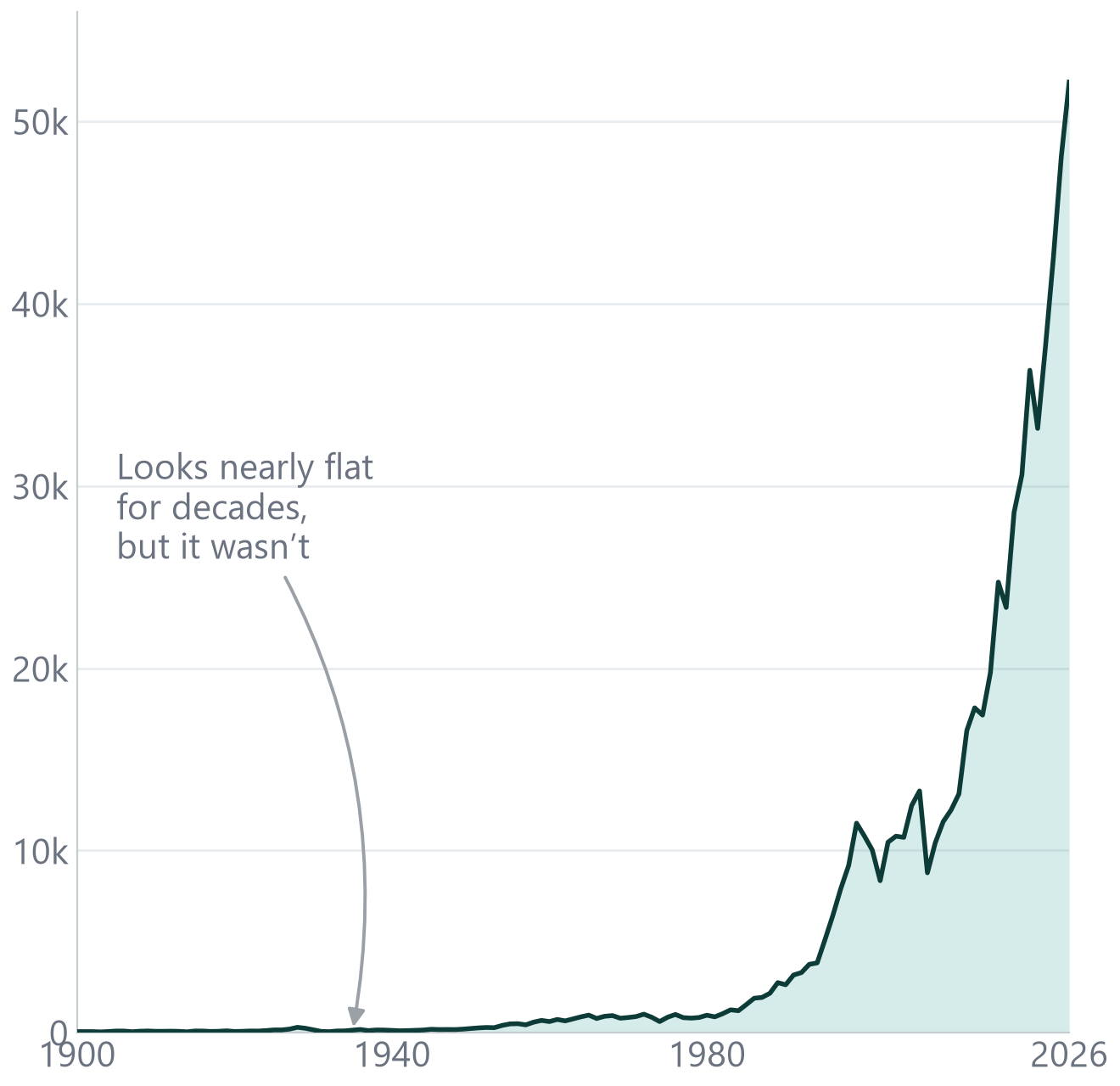
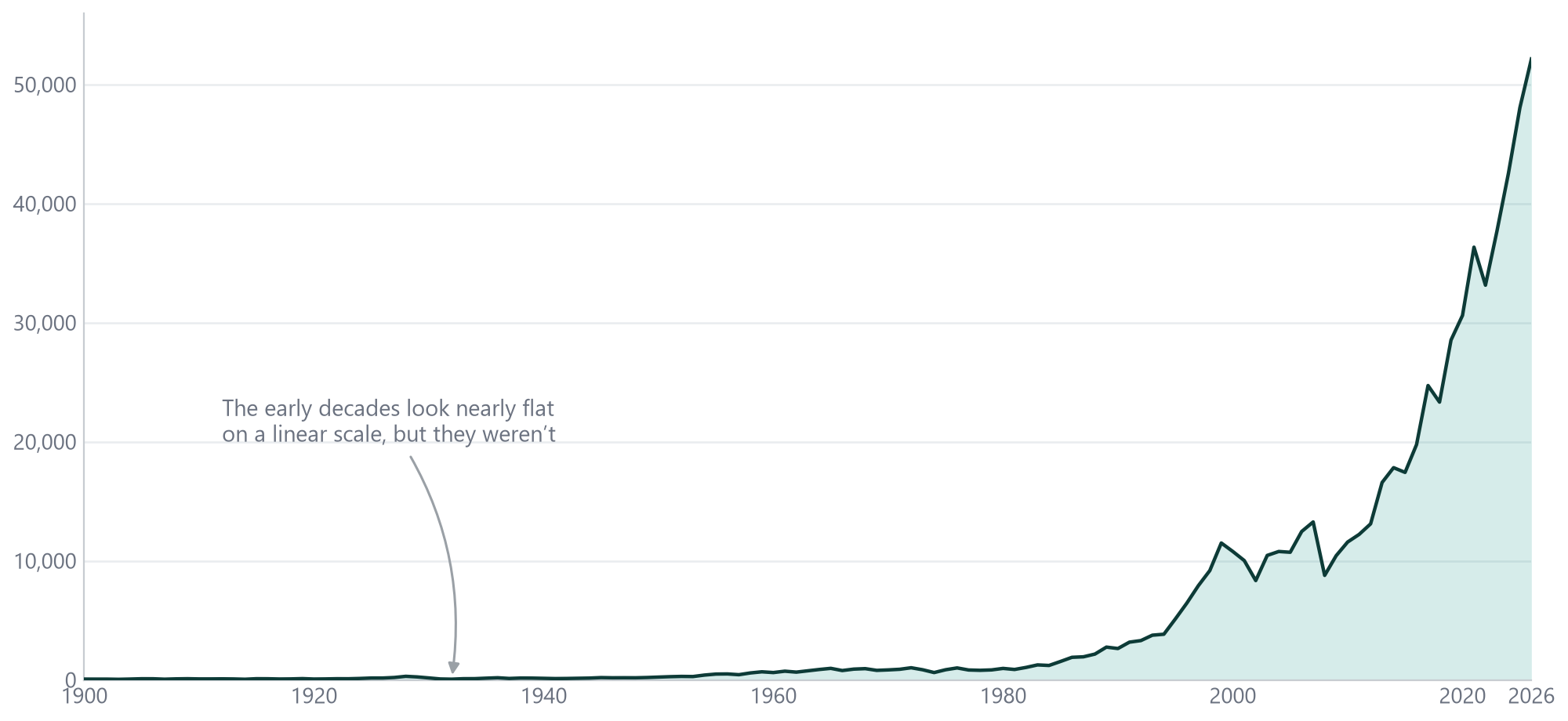
Start with a plain linear chart of the Dow Jones Industrial Average, from the beginning of the 20th century right up to today. It looks like a rocket: nearly flat for decades, then a near vertical climb. That picture is misleading. The long "flat" stretch actually hid painful losses and powerful rallies. On a linear scale, the early history simply gets crushed against the bottom.
Replot the same data on a logarithmic scale, where equal percentage moves take equal vertical space, and the real story appears: alternating eras of growth and stagnation. The teal bands mark secular bull markets, where staying fully invested let gains compound. The amber bands mark trading zones, where the market churned sideways for years and buy-and-hold produced almost nothing.
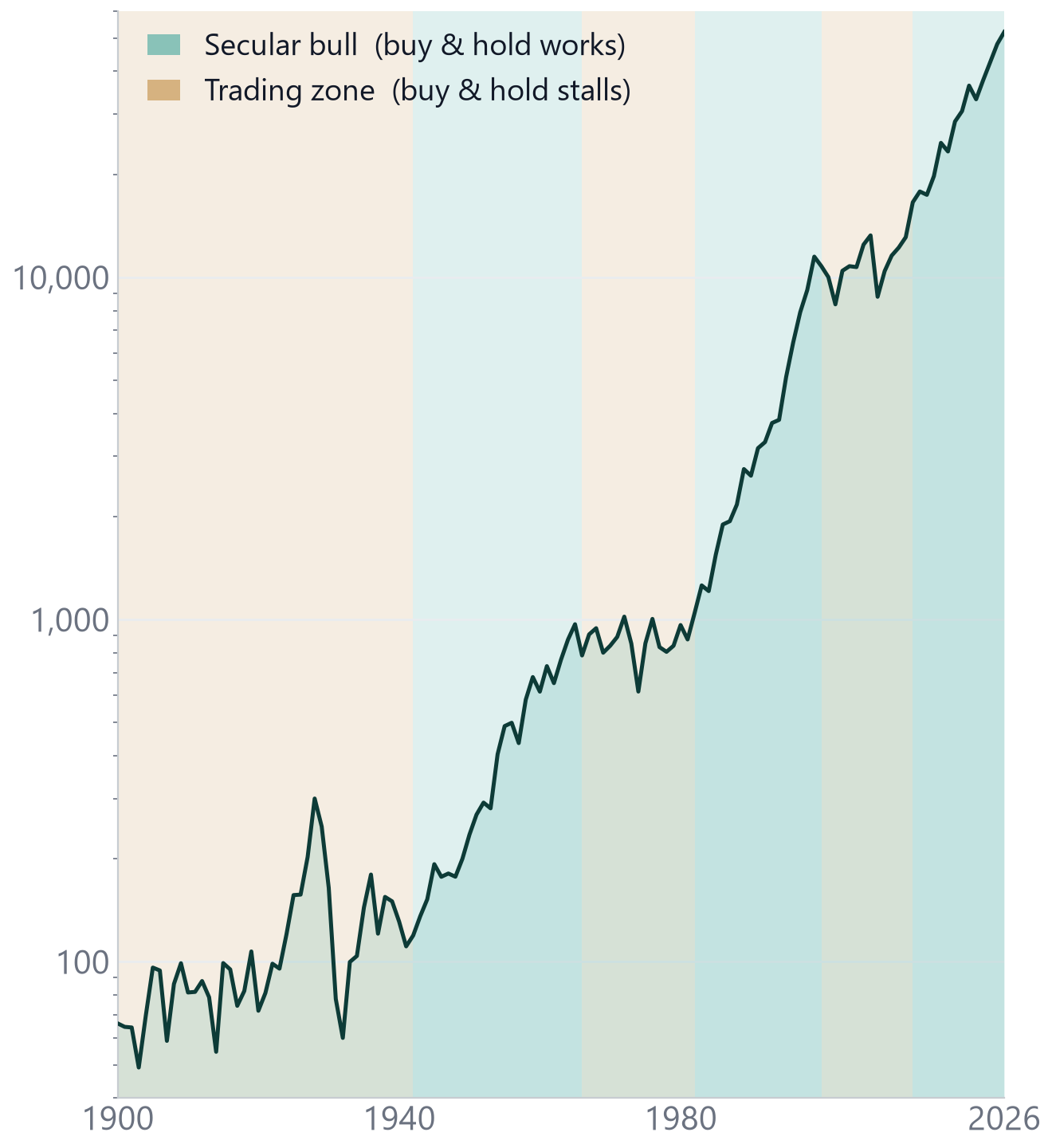
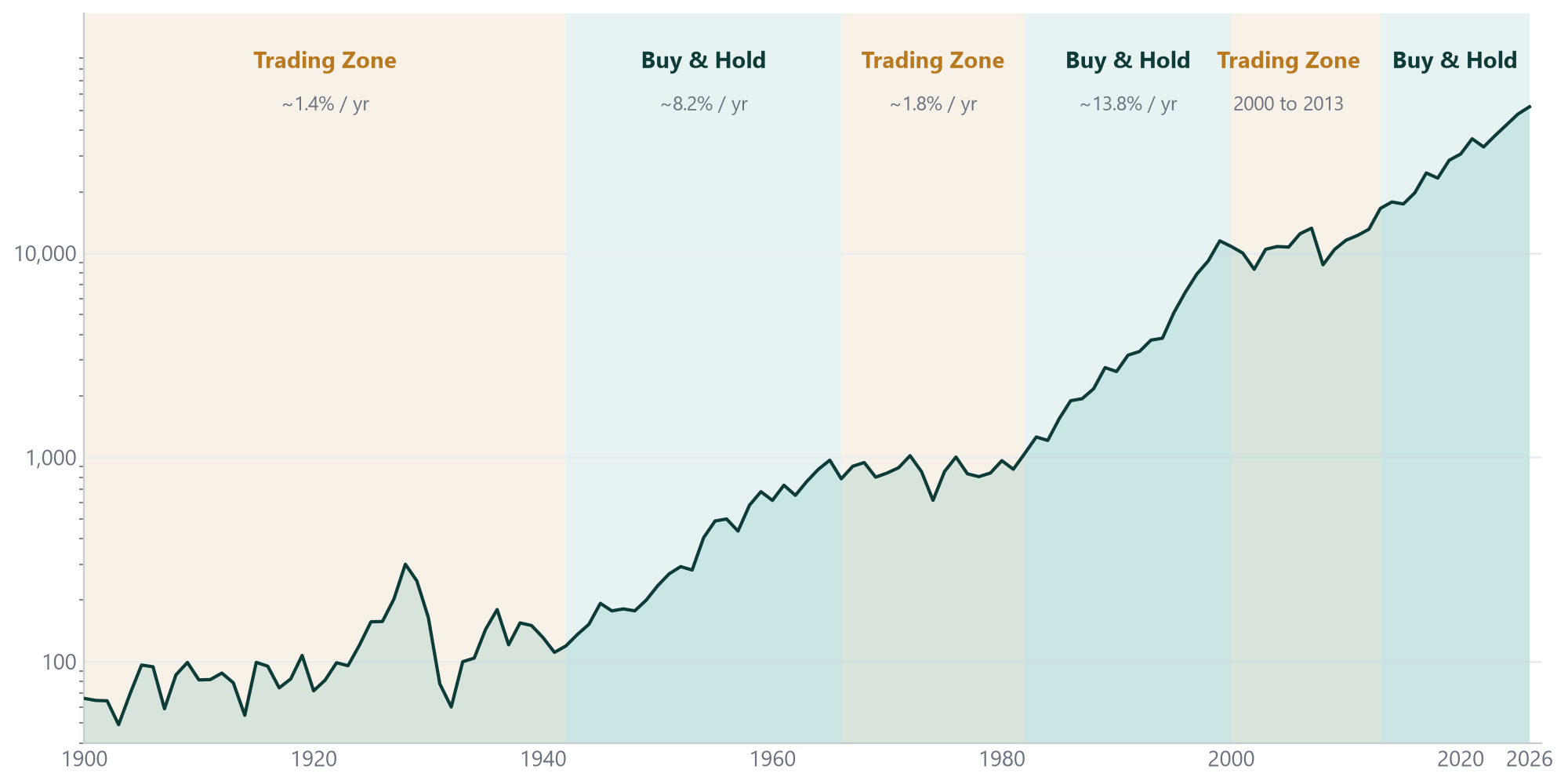
Two eras stand out as genuinely devastating. The 1929 to 1932 collapse erased about 90% of the Dow's value. The 1973 to 1974 bear cut it roughly in half. And notice what a yearly chart hides: the 1987 crash barely registers, because the Dow still closed 1987 higher than it opened. A single data point per year smooths right over a 22% single-day drop.
The quieter danger is the trading zone. From 1900 to 1942, the Dow gained only about 1.4% a year in price. From 1966 to 1982, about 1.8% a year. That is sixteen to forty years of going almost nowhere, with dividends the only real reward for holding on.
The most recent trading zone ran from 2000 to 2013. Packed inside it were two full bull-and-bear cycles: the 2000 to 2002 dot-com bust (the S&P fell 49%), a recovery into 2007, then the 2007 to 2009 financial crisis (the S&P fell 57%). An investor who bought at the 2000 peak waited thirteen years just to get back to even. In 2013 the market finally broke out to new highs above the 2000 and 2007 ceilings, ending the secular bear.
There were long stretches when buy-and-hold worked beautifully. From 1942 to 1966, the Dow rose about 8.2% a year in price. From 1982 to 2000, about 13.8% a year. Those were the times to ride the stock funds and let them run.
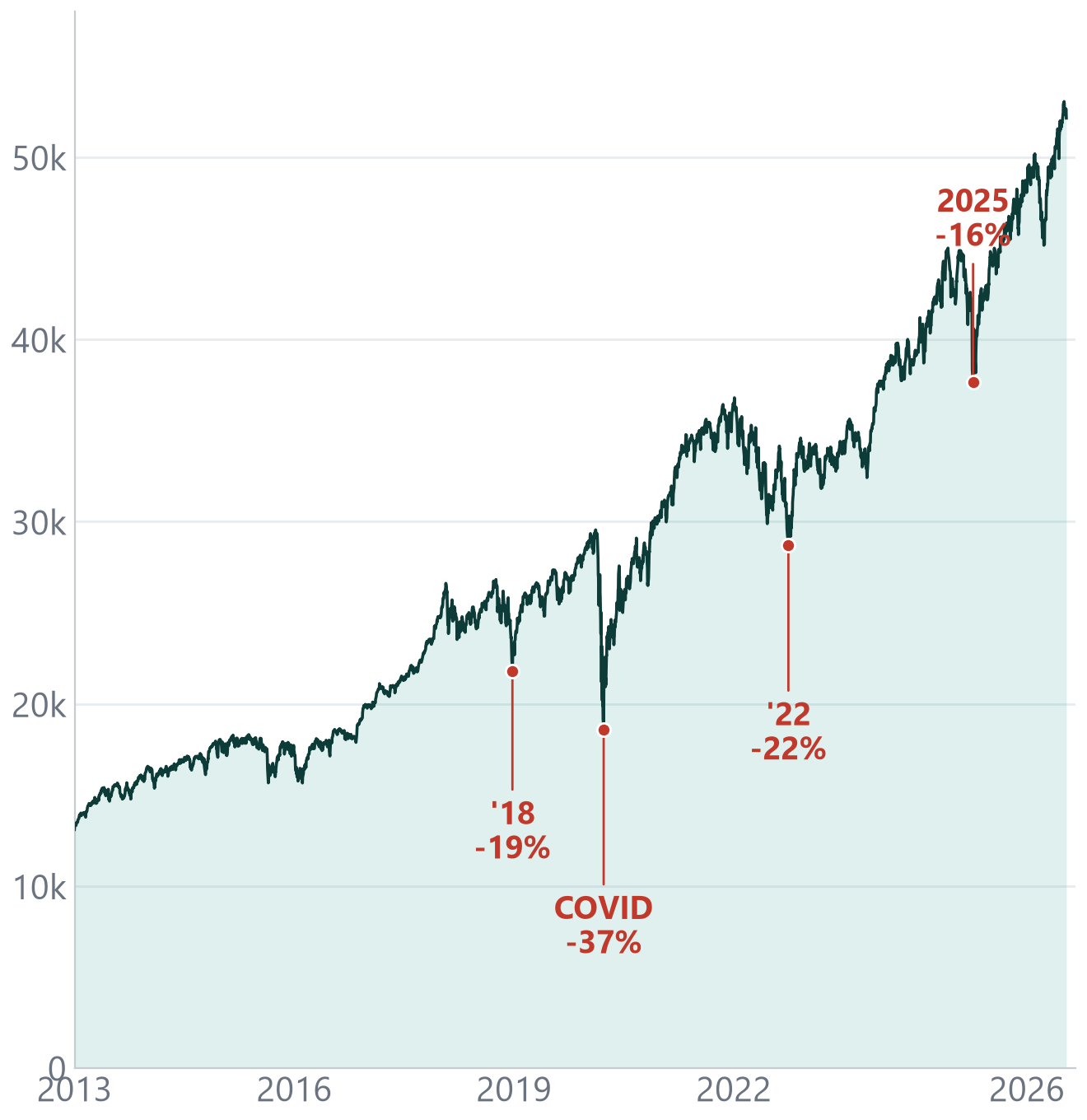
The 2013 breakout began the secular bull market we are still in today. Buy-and-hold is a perfectly valid approach during a secular bull, when it is wise to be heavily weighted in the stock funds. But even a secular bull contains sharp, frightening drawdowns, and that is exactly where our methodology earns its keep: staying invested for the compounding, while managing risk on the way through.
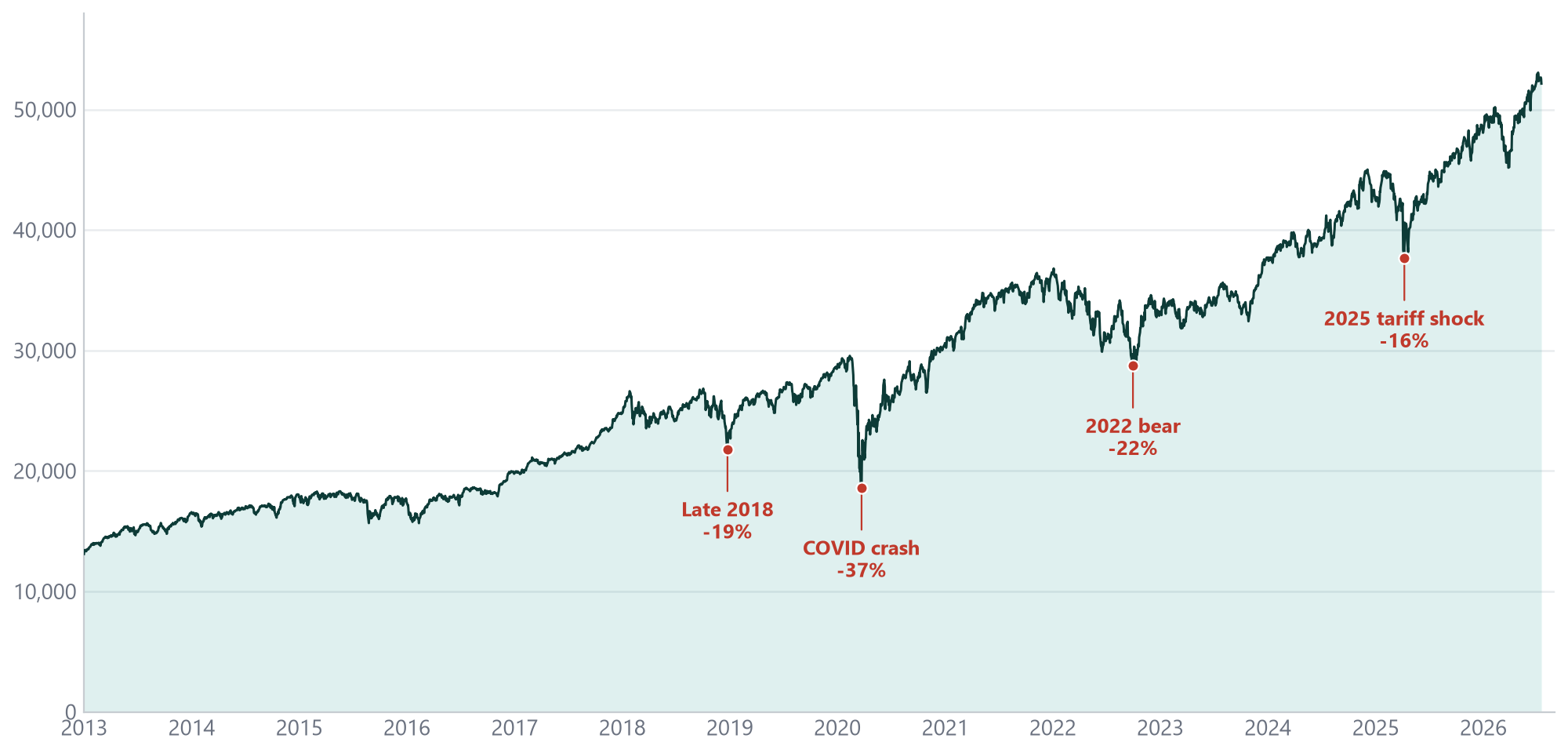
A secular bull is not a smooth ride. The current one has repeatedly tested anyone who simply held on.


The chart tracks the current bull from its 2013 breakout. Four times it delivered a gut check: a nearly 20% slide into late 2018, a 37% crash in about five weeks during the COVID panic of 2020, a 22% decline through 2022 as the Fed hiked rates (the S&P fell 25%), and, most recently, the spring 2025 tariff shock, which triggered the fastest correction in years and the largest two-day dollar loss in market history before rebounding once the tariffs were paused.
Buy-and-hold means living through every one of those, all the way to the bottom. Our job is to stay allocated for the upside while protecting capital when the risk environment turns, so our subscribers are not forced to simply endure the drawdowns.
As of mid-2026, the bull remains intact. The Dow set record highs above 53,000 in July, its best first half since 2021, on the back of three straight double-digit years for the S&P 500 (2023, 2024, and a 17.9% total return in 2025). Encouragingly, most of that gain has come from real earnings growth rather than stretched valuations, a healthier foundation than the late stages of past bull markets.
But the risk environment is never static. Valuations are elevated, policy and geopolitics keep delivering shocks like the one in April 2025, and every secular bull eventually gives way to a secular bear. The cycle will turn again. It always does. The question is whether your TSP will be positioned for it.
In an uptrend, we stay allocated to the stock funds. In a sideways grind, we don't force a trade just to have one. That is the whole method. We don't try to predict the future. We respond to what the market is telling us, one allocation decision at a time. Our subscribers don't need to monitor the markets themselves. That is what we do.